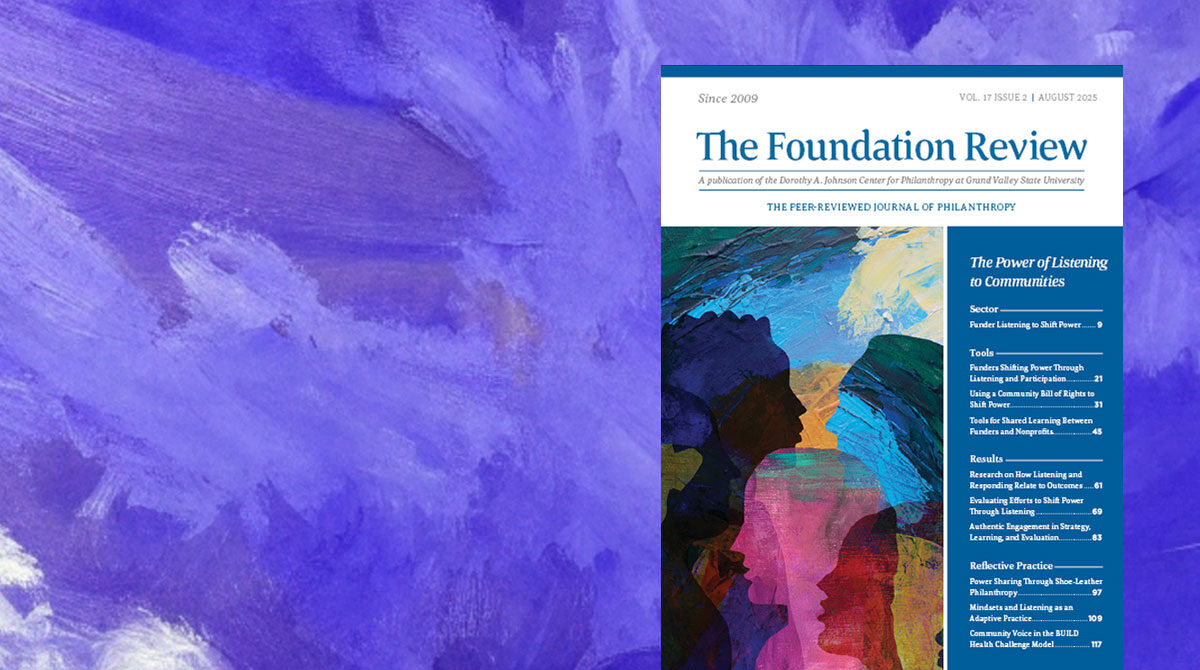
Editor’s note: We’re proud to highlight a special issue of The Foundation Review, “The Power of Listening to Communities,” sponsored by initiative partner Fund for Shared Insight. This collection marks an important moment for the field, bringing together learnings about how community-centered listening practices have the power to reshape philanthropy for the better. In an occasional blog series, we’ll hear directly from the authors featured in the special issue, lifting up their perspectives, calling out lessons learned, or offering updates on their work.
This post by Shared Insight’s Gita Gulati-Partee, Rick Moyers, and Melinda Tuan, co-authors of the special issue’s framing article, revisits what funder listening to shift power actually means and why the definitions matter.
In 2025, we collaborated on the framing article that kicked off “The Power of Listening to Communities,” Volume 17 Issue 2 of The Foundation Review, the peer-reviewed journal of philanthropy. Our article drew on an earlier post published at Fund for Shared Insight, sharpened by comments from editors and peer reviewers and evolution in our own thinking as we discussed and refined these ideas in conference and peer settings with leaders in philanthropy.
While we hope you will read the full Foundation Review article, we also want to present its key ideas in an even more accessible format and within the context of the Listen to Community initiative.
We believe that over the past few years, listening has become an expected standard in philanthropy and the social sector. As our colleagues at the Center for Effective Philanthropy reported earlier this year, most nonprofits — and most funders — say they listen. Few people are willing to argue that listening isn’t needed, or is a bad idea.
But with that increased acceptance comes the potential for confusion, because listening can mean many different things. Done poorly, listening can be performative and extractive. Listening is only meaningful if it leads to different behavior and choices on the part of those doing the listening and better outcomes and greater ownership and agency for those being listened to. Listening done right, as we define and advocate it, can shift power.
Listening is only meaningful if it leads to different behavior and choices on the part of those doing the listening and better outcomes and greater ownership and agency for those being listened to.
Why do we link listening and power?
For funders, we define listening as an ongoing, intentional, systematic, and relational effort to gather, understand, and respond to the perspectives and aspirations of those who are most impacted by our decisions — and yet often least consulted by philanthropy and nonprofits.
Like most everything involved with philanthropy, listening has a power dynamic to it, so we must also understand the meaning of power in this context. Power is another common term most often used in the sense of exerting control and having the ability to enforce one’s will over others. Under this narrow conception, philanthropy clearly holds power by controlling resources and conditions for funding. To be sure, some segment of philanthropy is quite comfortable with this definition and exercise of power.
But for funders that sincerely seek to contribute to social progress, a more useful definition comes from Dr. Martin Luther King Jr., who defined power as “the ability to achieve purpose … the strength required to bring about social, political, or economic changes.” By themselves, funders don’t inherently hold power to achieve justice-oriented purposes. This can be done only by working in partnership with others, particularly impacted communities, and building their collective power. This reframing opens the possibility for funders to exercise “power with” rather than “power over” — with funders working alongside communities to effect change.
By themselves, funders don't inherently hold power to achieve justice-oriented purposes. This can be done only by working in partnership with others, particularly impacted communities, and building their collective power.
What do we mean by listening to community?
We understand that many funders see listening to grantees as the primary way they listen to community. And we believe that funders should listen to grantees, and that listening in partnership with grantees is a way to respect the expertise of grantee organizations and reinforce the importance of nonprofits listening to their constituents. At the same time, we recognize that:
- Grantees represent only organizations that have successfully navigated existing funder systems and processes
- Not all grantees have deep community connections or listen effectively
- Relying solely on grantees as proxies means funders may miss perspectives from those who haven’t been able to access traditional funding channels and leaving a consequential power dynamic unchanged
For those reasons, we believe funder listening should go beyond grantee relationships to include direct engagement with impacted communities — particularly those who have been most harmed and made “least heard” by structural racism and other systemic inequities. As we said in the Foundation Review article, we advocate for funder listening that:
- Advances equity. Engaging in multiple forms of listening, from systematic feedback loops to participatory practices to community-driven processes, lays the groundwork for making lasting systemic change. It offers an opportunity for funders to hear from — and work shoulder-to-shoulder with — impacted communities and people who are experts in their own lives and have myriad assets and capabilities to bring to bear on the issues and causes that funders seek to address. Equity can be advanced both by how listening happens and what changes because of it.
- Engages in an explicit analysis of power and how to shift it. Funders have historically exercised outsized power, and that dynamic, if not considered and addressed, can result in funder listening that is extractive, transactional, or just reinforcing what funders want to hear. Funders should approach listening with a clear understanding of how power currently operates and with specific attention to shifting power to people and communities most impacted, but not typically consulted, by philanthropy and nonprofits.
- Is grounded in relationships and partnership. Research from our learning partner (ORS Impact, 2021) suggests that listening processes that are most effective at advancing equity and shifting power involve being in relationship and partnership throughout the process — from framing the initial conversations to making meaning from what is heard to figuring out how to respond. These authentic partnerships are built on open channels of communication, mutual accountability, and shared decision-making.
- Is an ongoing process and commitment, not a one-time activity or exercise. As such, funder listening to shift power adheres to the five steps of a high-quality feedback loop, which includes closing the loop — circling back to those who shared their perspectives to let them know what you heard and what you will do in response — and continuing the relationship.
Why these definitions matter
Being precise about what we mean by listening to community is not an academic exercise. When funders engage in one-time or superficial listening that is not grounded in reciprocity and relationship, without a clear power analysis and an equity mindset, they can actively cause harm. Communities end up frustrated, trust is eroded, and resources are diverted to programs and projects that communities neither want nor need.
This is particularly true for the place-based funders who are the focus of the Listen to Community initiative. Many place-based funders work in a tighter ecosystem, have a local presence, and may be more deeply invested in outcomes at the local and neighborhood level. While the consequences of botched listening can linger for years, the building blocks for a different kind of listening and accountability are also in place.
The question is whether funders reinforce existing power structures through status quo activities or challenge existing power structures by listening to community and changing based on what they hear — to create something different and better. In an era when philanthropy faces growing scrutiny about accountability and relevance, listening to community offers a path grounded in trust and working toward the shared purpose of supporting a community’s self-determined goals and needs.
Gita Gulati-Partee
Equity, Diversity, Inclusion Partner, Fund for Shared Insight

Rick Moyers
Communications Director, Fund for Shared Insight

Melinda Tuan
Managing Director, Fund for Shared Insight