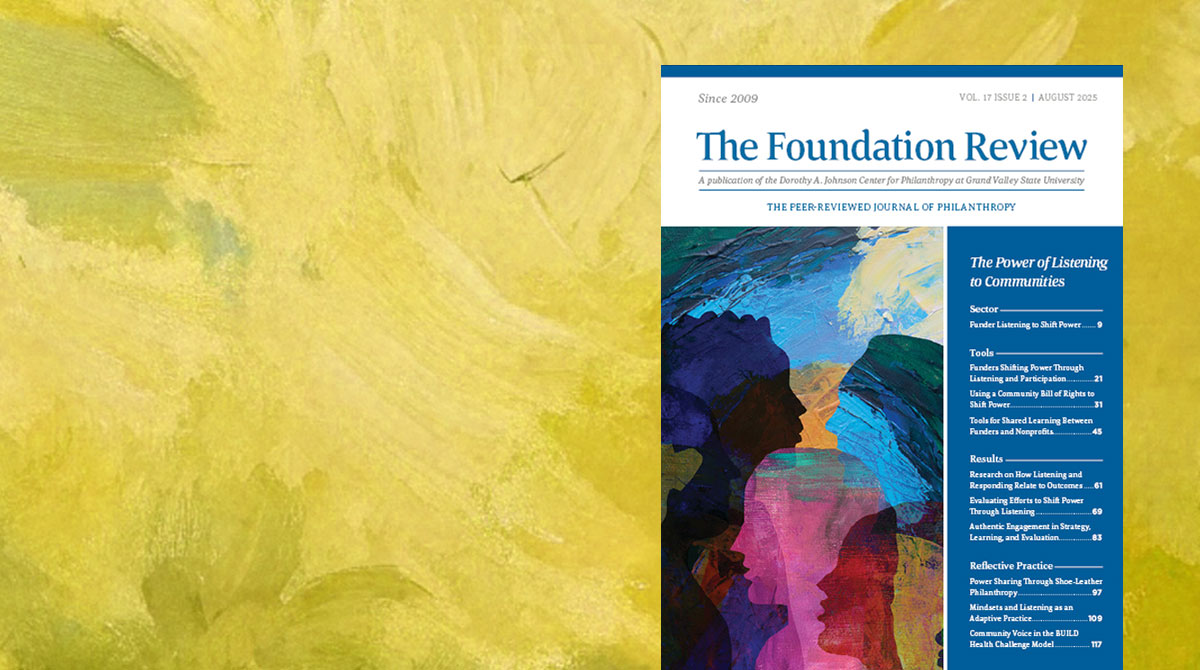
Editor’s note: We’re proud to highlight a special issue of The Foundation Review, “The Power of Listening to Communities,” which brought together learnings about how community-centered listening practices have the power to reshape philanthropy for the better. In an occasional blog series, we’ll hear directly from the featured authors, lifting up their perspectives, calling out lessons learned, or offering updates on their work.
In this post, Melissa Monbouquette, executive director of The BUILD Health Challenge, grounds advice for funders ready to build a listening practice in BUILD’s own experience shifting from gathering feedback to sharing power in decision making.
From its start in 2015, The BUILD Health Challenge® (BUILD) understood that strong partnerships between foundations, local nonprofits, residents, and other stakeholders would be the key to achieving its aims. A national funder collaborative, BUILD, for which I serve as executive director, has invested over $30 million in local cross-sector, community-based collaboratives to improve health equity by moving upstream and amplifying community power.
In 2021, in the wake of a turbulent and transformative year for residents and community health leaders across the country, BUILD opened the door to our community partners even wider, inviting them to work with us on how to shift our strategies and practices to better meet the moment.
To get started, we asked the evaluation consulting firm Success Measures to facilitate a Listening Tour, gathering input from dozens of stakeholders. Among the lines of inquiry, we wanted to know what they thought community- and racial-equity centered approaches could look like for BUILD.
In an article I co-authored for a special The Foundation Review issue on “The Power of Listening to Communities,” we reflected on how that initial engagement turned out to be a steppingstone to a new way of working. Today, we have moved from gathering feedback to integrating community voice and shared decision making into our operational framework and culture. Our journey to get here was as intentional as it was unpredictable, but it has made our work more community-centered, more impactful, and more resilient than ever.
Along the way, BUILD recognized five practical – and important – steps for any funder looking to launch and sustain a listening practice to take. Each of these steps is fundamental in building trust with key stakeholders, including community members and funding partners, and to ensuring that listening moves from checking a box to becoming an ingrained way of working towards shared goals:
Start where you can.
Why it’s hard: Community listening has been recognized as a best practice and an effective method for building relationships and creating impactful community-centered initiatives for many years. When we know something works, we’re often eager to dive in headfirst. On the flip side, there might be heavy resistance – internally or externally – to changing established processes for making decisions. Oversteps and missteps can unintentionally do harm.
Why it matters: Finding an opening is the first step. With patience, you have the opportunity to build deeper relationships through small-scale community engagement opportunities, or develop experience and confidence across team members by piloting and refining with an individual issue area or program before scaling across the organization. Over time, this practice and learning will grow to be more comfortable, effective, and sustainable.
Utilize a learning mindset and tools.
Why it’s hard: On this listening journey, it is likely that funders are going to hear something we disagree with. Community members might have a different perspective on how important an issue is, what’s causing it, or the best solution. Communicating and hearing differences of opinion is challenging even under the best of circumstances, even without the history and inherent power dynamics of a funding relationship.
Why it matters: Tools, such as discussion guides, workbooks, and neutral facilitators, that allow us to share, capture, and discuss differences of opinion can help us navigate tension. They can offer frameworks for understanding where our differences come from and how to move forward together. Ultimately, shifting from viewing differences as challenges to recognizing them as opportunities for learning and growth can help create more effective programs and initiatives that have greater buy-in from the community.
Make your case.
Why it’s hard: Funders, including their board members, take great pride in the work they do, their fiduciary responsibility, and the knowledge and relationships they have in their community. Engaging in, and acting on, community listening practices may feel like it encroaches on their role and experience.
Why it matters: Bringing leadership along on the journey is critical for institutional change. Leveraging different assets and approaches – like evaluative assessments, research from the field, and community advocacy – can create the case for why community listening makes your philanthropic practice stronger.
Dedicate funding.
Why it’s hard: Resources are precious! Depending on your internal processes, accessing them may also require advanced planning.
Why it matters: Dedicating resources to your community listening practice will make it more likely to succeed. This might look like allocating staff time; ensuring that residents are compensated for their time; or facilitating community participation by providing childcare, meals, translation services, and transportation. Some engagements might benefit from specific venues, neutral facilitators, and training as well. Investing in evaluation can also be a powerful long-term tool to bring organizational leadership and other stakeholders along on your journey.
Ensure that listening has room to grow into practice change and decision making.
Why it’s hard: When we don’t know what we might hear, it can be hard to plan how we might respond – or if it will even be possible to respond.
Why it matters: Successful listening practices are based on trust and humility. Demonstrating intentional action based on what community partners are sharing with you is one of the most powerful ways to build trust and grow future relationships. While the goal of listening practices is to amplify community power, they become extractive without a plan for response and action. Keeping the destination in mind can ensure that we don’t lose focus.
For BUILD, following these kinds of steps has resulted in an increased emphasis on community power and racial equity, greater flexibility and trust in our grantmaking, and the adoption of increasingly participatory structures. Resilient and authentic relationships are at the heart of our work. They are built on bi-directional and transparent communications, shared decision making, and a recognition that to go further, we must go together.
My co-author on the Foundation Review article, Jessica Mulcahy, co-vice president of Success Measures, once noted to me that it was unusual how eager BUILD was to implement these changes because many funders found it challenging. My first reaction was surprise – these practices make my work at BUILD easier.
While there is significant effort involved, the involvement of our local partners in our planning and decision making ensures that we are heading in the right direction. It gives me greater confidence that we will know if something is not working before it becomes a problem, because we have put in the time to build trusted relationships with those who will let us know. At the end of the day, I am confident that the impact of BUILD’s resources will be maximized by the people doing the work on the ground – because they designed it that way.

Melissa Monbouquette
Executive Director of The BUILD Health Challenge, de Beaumont Foundation