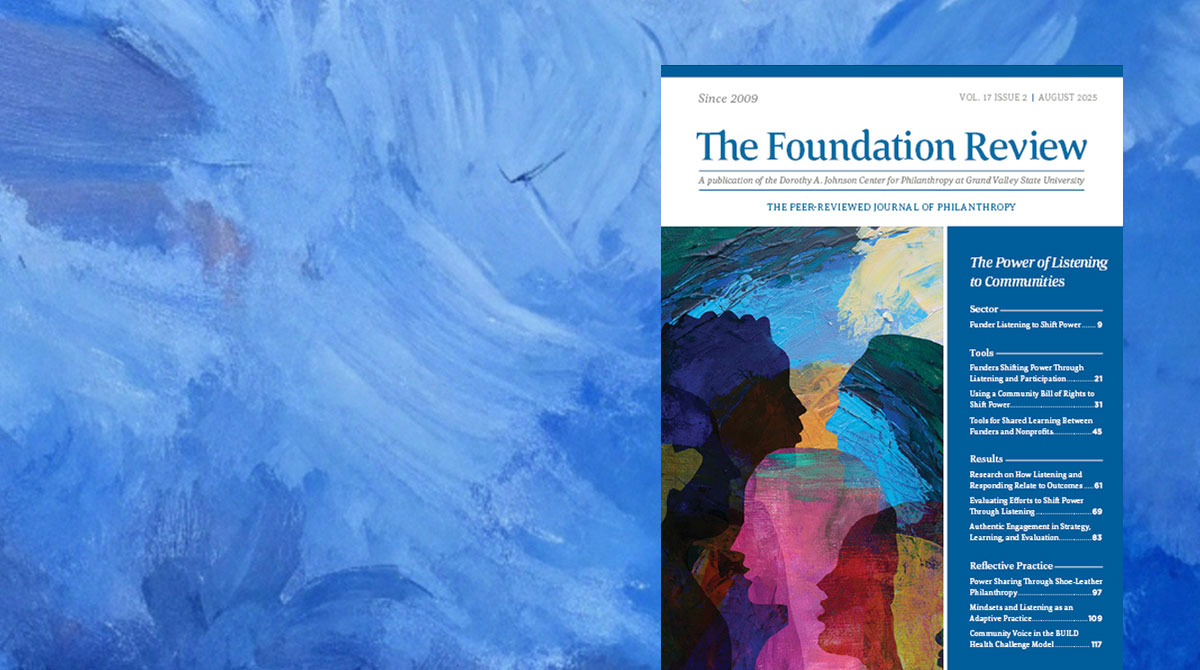
Editor’s note: We’re proud to highlight a special issue of The Foundation Review, “The Power of Listening to Communities,” sponsored by our partner Fund for Shared Insight. This collection marks an important moment for the field, bringing together learnings about how community-centered listening practices have the power to reshape philanthropy for the better. In an occasional blog series, we’ll hear directly from the authors featured in the special issue, lifting up their perspectives, calling out lessons learned, or offering updates on their work.
In this post, Valerie Threlfall updates her review article about funder-nonprofit partnerships by sharing new learnings from Listen4Good’s co-listening projects in Arizona and New Jersey — from how to set up multi-stakeholder listening for success, to the surprising ways community feedback drives change at both the site and systems level.
In the August 2025 special issue of The Foundation Review, we made the case that philanthropy has a genuine — and largely untapped — opportunity to listen to community in partnership with grantees. Rather than viewing community feedback as a discrete project for either a funder or a nonprofit alone, we argued that collaborative listening provides a scalable approach for funders and nonprofits to center community voices in their respective decision making.
Now, having completed two major listening projects and being mid-stream with two others, we have an even clearer picture of what it actually takes to make co-listening work.
It honestly feels like a lifetime ago when we wrote the Foundation Review article. Since then, the needs and pressures facing nonprofit organizations continue to mount and there remains a persistent gap between how well funders believe they understand the needs of their grantees and the communities they serve and how well nonprofits believe funders understand those same needs.
The good news, though, is that tools and resources exist to help funders stay connected and get proximate to community needs. This post lifts up concrete learnings from two recent collaborative listening projects that Listen4Good implemented with funders and nonprofits on the ground:
- In Arizona, we supported a collaboration between government funder First Things First and 40 early-childhood family resource centers (FRCs). Aggregate feedback from more than 3,100 client families was collected in partnership with resource centers and the funder.
- In New Jersey, we helped The Tepper Foundation, food access organizations, and housing providers collaborate to gather feedback from more than 2,800 end clients.
Continued belief in the promise of collaborative listening
We still believe, as we said in the article, (“A New Opportunity for Funder-Nonprofit Partnership: Advancing Shared Listening Efforts to Learn From Community”), that the “opportunity to do meaningful partner-based listening is stronger than ever before,” and that “given the growth of nonprofit listening efforts which have proliferated more rapidly than direct funder listening, philanthropy has a promising opportunity to leverage structural shared listening solutions.”
Both the Arizona and New Jersey projects were designed with the principles we outlined in the piece in mind: shared responsibility across funders and nonprofits, collaboratively developed survey questions, and a commitment to surfacing insights that can inform both systems-level improvements (funders) and site-level improvements (nonprofits).
The promise of this approach is that it addresses many of the issues that limit foundation listening efforts, both how often they happen and whether they last. For example, the practice of gathering community insights often falls outside regular foundation workflows, which leads funders to describe listening efforts as “a massive staff lift.” For others, actual proximity can be a barrier; foundations that are not geographically based or lack physical proximity to the communities they serve may struggle to maintain consistent, meaningful connections.
Co-listening addresses both. By dividing and sharing responsibilities across the steps of a quality feedback loop — from design to data collection to feedback response — these types of collaborations have the potential to draw on each party’s distinct roles and perspectives, and to create more relevant and actionable feedback.
Three reflections from our recent co-listening projects:
As we’ve piloted this work with funders and nonprofits, we’re appreciating its complexity, but also witnessing its potential. Some of our recent learnings:
Set up matters.
Ensuring that multi-stakeholder data collection benefits both grantees and funders takes a lot of upfront scoping, design, and expectation management. To use a potentially tired metaphor, it’s important to gain early consensus on who’s driving the bus and who’s riding shotgun, especially regarding inquiry/survey design and content themes. Even in a highly collaborative effort like co-listening, we’ve learned through experience that one group must ultimately take the lead. Transparent and candid prep work is vital to yield the most actionable and relevant data.
In Arizona and New Jersey, both funders and nonprofit organizations had input, but leadership was held differently. In one project, the funder led inquiry design and sought input from nonprofit partners. In the other, the nonprofits led the focus of the inquiry, with targeted funder input.
When a funder leads, the primary risk is less buy-in from nonprofit organizations. Work must be done to ensure the project isn’t perceived as “give and no get.” When nonprofits lead, which is especially valuable from a power-sharing perspective, it’s important to ensure the feedback themes selected can also contribute to funders’ current conversations around strategy.
Community feedback can generate multi-level takeaways.
One of the core arguments in our original article was that co-listening can surface both site-specific and systems-level improvements. These projects bore that out.
In New Jersey, clients were asked multiple questions about service accessibility. Organizations got feedback on many site-specific operational improvements they could make to increase service access, ranging from better information, reducing wait times, and shifting hours of operation. But, the data also revealed a more systemic barrier — transportation — which was cited by 32% of housing clients and 17% of food access clients across organizations. In fact, transportation was the most common barrier cited by clients overall. This data was relevant to and raised questions for both the funder and the nonprofits.
Nonprofits got together in an L4G Learning Community to discuss the findings and what they could do in response. Based on their experience, they hypothesized that the data reflected systemic challenges with regional bus systems, limited transportation options for seniors especially, and financial pressure on families who lack funds for cars and gas.
One organization plans to hold community listening sessions to test these hypotheses and better understand the specific transportation barriers their clients are experiencing, learnings which can be provided back to the funder-nonprofit group. Meanwhile the funder is positioned to share the aggregate data with relevant partners.
In Arizona, community feedback data identified many site-specific improvements but at its core, affirmed the value of family resource centers, including their accessibility and community-grounded roots. Clients were extremely likely to recommend FRCs to others, with Arizona FRCs rating higher, overall, than Listen4Good’s national benchmark. Organizations can use this data to support their own fundraising and growth planning. At the same time, the funder plans to leverage this data to advocate for FRCs as a systems-level intervention for families in need and to drive better alignment of service delivery across regional providers.
The audience for co-listening projects is broader than we realized.
Our experience with these projects has shown us the value of sharing (anonymous) aggregate data even beyond the nonprofit grantees and funders who participated. Could intermediaries and advocacy organizations use this kind of feedback data to inform their efforts and energize systemic positive change for clients and community members? Is part of the responsibility of co-listening to share data across networks, not just within immediate partnerships, to facilitate change?
We’re excited to take on these questions and others as we do more projects and look for more opportunities to use community datasets to fuel social change. While there are inevitable power dynamics that surface in collaborative efforts between funders and nonprofits, there are many best practices to draw on field-wide as well as through our own growing understanding of the process and benefits of co-listening.
Listen4Good looks forward to reporting back as we continue to implement co-listening models. We recognize the complexity, but if there is one thing we know how to do as a field, it is to wrestle through these kinds of challenges, especially when the stakes for communities are this high.