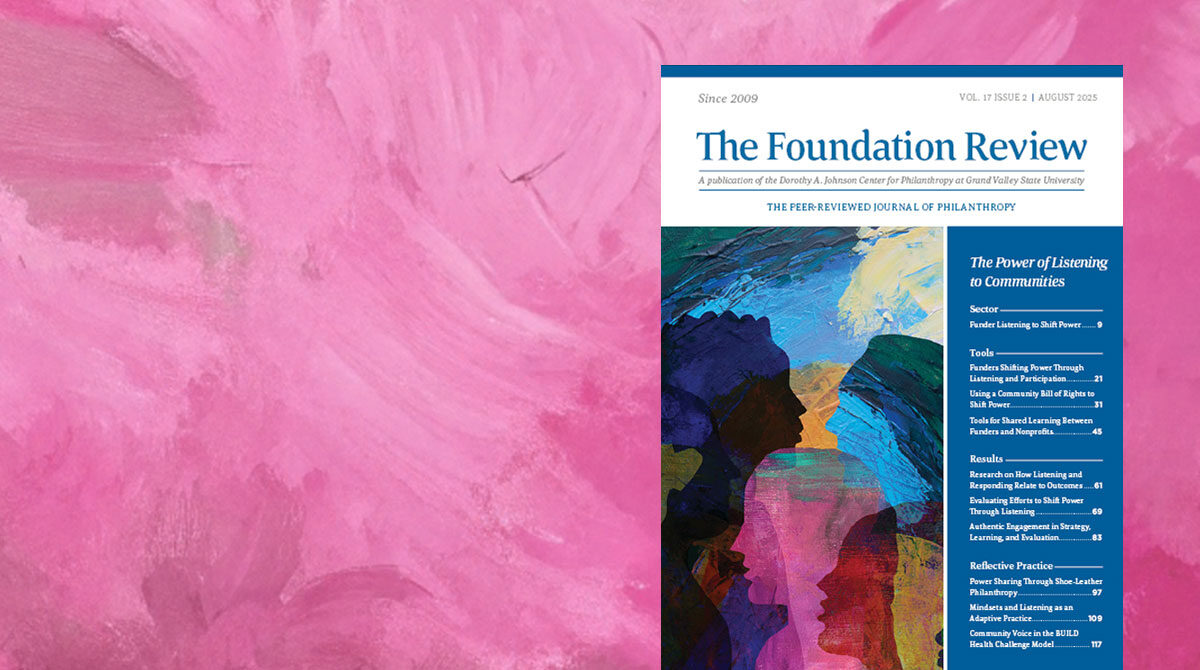
Editor’s note: We’re proud to highlight a special issue of The Foundation Review, “The Power of Listening to Communities,” which brought together learnings about how community-centered listening practices have the power to reshape philanthropy for the better. In an occasional blog series, we’ll hear directly from the featured authors, lifting up their perspectives, calling out lessons learned, or offering updates on their work.
In this post, Greater Hartford Gives Foundation and RTI International share new learnings on what it takes to make listening transformative — from the mindsets that shift power, to why the work is never really “done.”
Over the past decade, many funders have committed to centering the voices of communities most affected by structural racism, framing this change as moving from funder-driven decision making to shared authority with communities. While funders have invested in listening practices and participatory approaches, our article in a special issue of The Foundation Review, “The Power of Listening to Communities,” argues that these efforts often fall short because they are treated as technical fixes rather than adaptive changes.
Genuine listening for equity requires deep shifts in individual and organizational mindsets – changes in values, beliefs, and assumptions about power – rather than simply adopting new tools or methods. Without these deeper transformations, listening risks becoming performative, perpetuating gaps between equity intentions and actual practice.
Using the Greater Hartford Gives Foundation (formerly the Hartford Foundation for Public Giving) as a case study, we identified three core mindsets necessary for authentic listening that can shift power:
- Listening with humility, recognizing communities as experts and valuing their knowledge
Example: Hartford Gives created a new neighborhood beautification funding area after hearing interest in such efforts during conversations with community members. Instead of dismissing the idea of beautification as superficial, staff trusted what community members expressed. The foundation partnered with the City of Hartford to support the Love Your Block program, which funds resident-led projects, such as murals, clean-ups, and gardens, including those run by groups without formal nonprofit status.
- Listening for purpose and action, acting meaningfully on what is heard
Example: After hearing that artists of color felt excluded from a foundation landscape study and that prior input had not led to change, Hartford Gives created an advisory group, Artists of Color Unite!, and a dedicated arts grantmaking team. The advisory group did not just react to proposals, it helped design new funding approaches, including regranting to individual artists and a fellowship program pairing artists with arts institutions.
- Listening toward belonging, ensuring communities see themselves reflected in decision making and structures
Example: Rather than seeing community input as peripheral or symbolic, the foundation approached listening as central to strategy and grantmaking, grounding its work in ongoing engagement with residents, grantees, artists, and community leaders. This included a CEO listening tour, systematic review of prior community feedback, and a commitment to letting what they heard meaningfully shape decisions — even when it pushed the foundation in new directions.
These experiences at Hartford Gives show how new mindsets can reshape grantmaking priorities, internal systems, leadership practices, and organizational culture. We learned that listening for equity is a transformative process requiring sustained commitment, aligned and reinforcing structures, and ongoing action that moves listening from a discrete activity to a defining feature of equitable philanthropic practice.
We also identified some lessons:
- Key conditions can support mindset change. Aligned hiring, a learning-oriented culture, and sustained commitment from leadership can help normalize new ways of thinking about community knowledge and power.
- Adaptive change can happen through practice. Funder mindset can shift as new listening practices lead to benefits, like clearer priorities and stronger community trust. Listening differently can catalyze thinking differently.
- Listening must be ongoing and embedded in the culture. Power-shifting requires durable systems, committed resources, and authentic relationships that make listening part of how the foundation works across the board.
Never “done”: An example of how we listen and learn as we go.
In this blog, we want to highlight another critical mindset we’ve identified: letting go of the idea that we will ever be “done” improving our practices and processes. with this, we move away from perfectionism and toward continuous learning, expanding our opportunities to gather and process information through listening.
The never done mindset is especially visible in our Grants Process Team, which has seen additional changes since we first shared about it in The Foundation Review.
The team, a cross-functional workgroup convened in 2021 to overhaul our grants process, focused on reducing administrative burden for staff and partners, making better use of technology, and centering equity in our grants process. While the team launched a redesigned process in 2023, its work didn’t stop there. Rooted in the idea that nonprofits and other community partners are the experts who can provide nuance and insight into what works and what doesn’t, the team continues to meet to monitor and improve processes.
Over time, the team has sought grantee perspectives at multiple points and through multiple methods, including artifact reviews (emails and officer notes), an open-ended survey, and beta testing a new application. It has also implemented an ongoing listening mechanism: an anonymous, voluntary post-application survey automatically sent to all applicants. The survey instrument was refined and piloted with the input of 15 grantees and with the guidance of equity-focused evaluator Vanessa Segundo, PhD. Responses to the survey are reviewed regularly, and adjustments are made based on feedback. A Feedback Summary shares useful updates about the grants process and shows partners how their perspectives shift and shape our decision making and operations.
Listening to nonprofits and grantees around the grants process is an accountability and relationship-building approach that complements our other listening practices. We believe it is also an approach that shifts power to the community as many of our grantees and their leaders themselves have lived experience with the issues and in the areas where we work — or they can act as critical connectors to those who do.
Letting go of the idea of being finished gives us freedom to continually listen, respond, and transform. It allows us to prioritize progress over perfection, and to see gaps not as failures, but as opportunities to learn and integrate new ideas. Ultimately, this mindset, along with the others we describe in the review article, helps us build a more responsive, equitable, and effective experience for our partners and the people and communities we serve.

Jay Feldman
Senior Education Researcher, RTI International

Kate Szczerbacki
Director of Learning, Evaluation, and Capacity Building , Greater Hartford Gives Foundation

Nitya Venkateswaran
Senior Education Researcher, RTI International