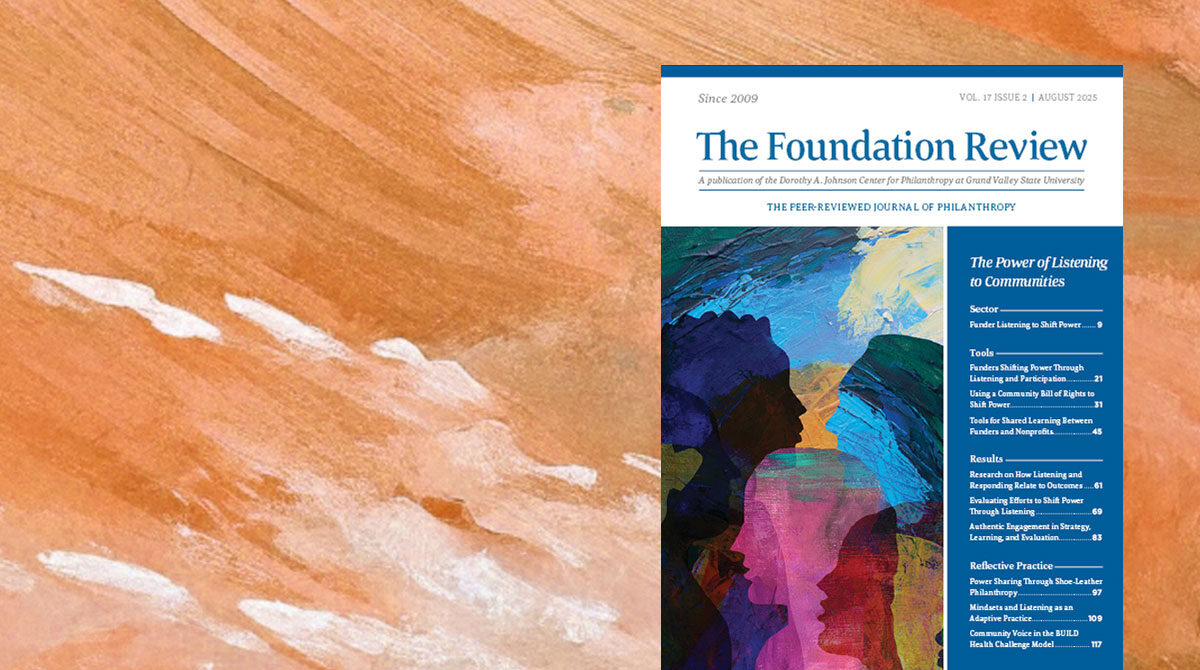
Editor’s note: We’re proud to highlight a special issue of The Foundation Review, “The Power of Listening to Communities,” sponsored by our partner Fund for Shared Insight. This collection marks an important moment for the field, bringing together learnings about how community-centered listening practices have the power to reshape philanthropy for the better. In an occasional blog series, we’ll hear directly from the authors featured in the special issue, lifting up their perspectives, calling out lessons learned, or offering updates on their work.
This post by Elizabeth Jordan, who co-authored an article with two colleagues at the Ruth Mott Foundation, tracks what the foundation has been doing since to meet its continuing commitment to community engagement, especially during a new strategic planning process.
In the spring of 2025, we reflected on the Ruth Mott Foundation’s 15-year journey of community engagement. We published an article in The Foundation Review, Community Engagement: A Core Practice on the Journey to Power Sharing, examining how our practices as a place-based family foundation in Flint, Mich., had shifted.
The changes we referenced included adding staff leaders with lived experiences relevant to our funding, , expanding the board beyond family members, creating a strategic plan driven by residents’ input, and building staff capacity to meet our charge. We also created a framework for community engagement and involved staff across the organization in tracking our engagement efforts. We committed to racial equity in our internal and external practices. And involved grantees in improving our processes and advocated with residents. When the Flint water crisis struck, we found the relationships we had built were vital in recognizing what residents were experiencing and championing an effective response.
In the months since the article was published, life has been lifin’, as the saying goes. We have seen federal funding be used as a weapon to discourage courageous work naming and addressing systemic inequities. As the usual checks and balances teeter, people power is even more urgent, including within independent philanthropic organizations that can shift power and voice to communities. In this context, we offer a glimpse of our work in the past few months and apply lessons from the article.
When we wrote the article, the foundation had just refreshed its mission, vision and values and was about to embark on an update to its 10-year strategic plan. The centerpiece of the strategic planning process was a series of community forums to gather input from residents. The data from the forums were to be used in the board’s strategic planning process with an eye toward launching the new strategic plan in late 2025 or early 2026. We committed to continuing to center community voices — which we honored, but not without some messiness.
Community Engagement Kicked Up a Couple Notches
Our 2025 strategic planning process took the core commitment to community engagement from our process 10 years earlier and kicked it up two notches. Here’s some of what we did to enhance our practice:
Involved the community in pre-planning
A year before the planned community forums, we formed a Community Engagement Committee (CEC) composed of 10 local residents from a variety of backgrounds. Their role was to advise us on the process of gathering community input, and we drew on concepts from Deepa Iyer’s Social Change Ecosystem Framework to think about how we collaborated. Committee members met once a month over dinner and were paid a stipend of $1,500 each for their expertise.
A team of staff rotated to guide meetings, which started with building relationships between CEC members and staff, using activities such as “I Am” fill-in-the blank poems and creating a collective playlist. We built context around the foundation’s mission, vision, values, and held one of the meetings at Applewood, the historical Mott family estate, to familiarize CEC members with the space. Over time, the group explored what they liked or didn’t like about engagement sessions they had participated in before and helped shape the vision for our forums. They helped select venues, suggested outreach strategies, and tried out the activities staff designed based on their input. Above all, they admonished us not to be boring.
Made it fun
We took the advice not to be boring to heart and drew inspiration from Priya Parker’s work on gathering to give each forum the feel of a family reunion. Whether held with youth at the local Boys and Girls Club, at a block club meeting, or with members of the general public at elementary gyms and community centers, every session shared some key elements. Food, of course, was essential, as well as a live DJ for an upbeat vibe. Photo displays of our community created an air of celebration and provided visual examples of past work. And, rather than set a program, the forums were self-paced so people could participate as they chose to. We used before- and after-action reviews and rapid-cycle adjustments (all practices of Emergent Learning) to improve from one forum to the next. Each activity was designed to help us understand how residents interpret concepts from our refreshed mission, vision, and values and what priorities matter the most. Activities included:
- Thrive Trees (based on Public Profit’s work) where people posted “leaves” about what it meant to thrive in their neighborhood/household and what places (other than their home, work/school, or place of worship) were most important to them.
- World Cafés set up with flowers and tablecloths to share ideas about what “justice” and “civic engagement” meant to them. Other café tables focused on what community resources participants saw as helpful.
- Token Voting let participants show what priority areas they thought were most important, and a Graffiti Wall gave room to draw or write expanded input about what they had in mind.
- Coloring tables and children’s books provided space for families. Interestingly, people of all ages seemed to find pleasure in coloring; adults as much as children participated in the activity.
Ensured access
We deepened our practice around equity through language access and fair compensation. This included contracting with a local partner to translate event materials into Spanish. We also hired Spanish interpreters for the sessions and provided ASL interpretation as needed.
Shared data
Staff recorded and coded every piece of input and then worked with CEC members to determine how best to share results with the community. Over a series of three “Data Simmer” sessions (developed by our Learning Officer drawing on lessons from Public Profit’s Dabbling in the Data), CEC members advised on possible formats for presenting data. As the name suggests, these were casual, conversational sessions intended to be approachable and culturally responsive. This was the final official role of the CEC.
The Messy Parts
In the Foundation Review article, we listed eight key lessons from our community engagement work until that time, and we’ve found that at least three of those are particularly relevant to our recent strategic planning process:
- Invest in staff and resources in proportion to the desired outcome.
This meant taking the necessary time to build rapport with the CEC, compensate them, and provide forum participants with a $10 gift card. In addition, the forums required a massive staff lift, with cross-department teams meeting weekly. (Unlike most foundations, ours includes both grantmaking functions and operation of a historic estate.) Some of the planning meetings required us to work through differences in team culture and style. Every staff member worked at least one forum and preparation took place over months to ground staff in the theory and practice of the forums. - Recognize that retaining power is the foundation’s natural default.
Part of the urge to retain power arose in our organizational culture of perfectionism. We like to do things right, and putting on a series of complicated public events where unexpected things are guaranteed to happen stretched us to lean toward spontaneity rather than control. Retaining power also surfaced when we changed the original timeline for finalizing and sharing the new strategic plan. We originally told participants we expected to share the plan — and how their input influenced it — before the end of 2025. Instead, we paused strategic planning to hire a new foundation president and ensure they could be involved. We updated residents and grantee partners about the delay, and assured them their input will inform our future strategy. Our new president has committed to centering the community input already gathered. Seeing that through is a vital part of retaining the community’s trust by sharing power. - Acknowledge the tension between foundation-driven and community-driven approaches.
Our refreshed mission, vision, and values commit us to work with the community for an inclusive Flint, using our power to pursue justice and commit to the long term. These are powerful notions, but there is still a reflexive impulse at times to revert to a traditional mindset of philanthropy. These impulses, for example, may include focusing too much on quantifying results or on charity rather than justice. These reflexes are at odds with where we have declared we want to go, and require board and staff to acknowledge them and set them aside when they occur.
A community-driven approach that the foundation has tried to pick up on is to weave more energy and fun into our everyday culture. Enjoying a staff playlist together is one way we do this, but we often forget to start off our meetings with music, as planned. It’s these messy elements — big ones, like foundation-imposed delays, to small ones, like failing to turn on the music — that underscore the push and pull of changing culture and practice. But they are also what teach us and propel us to improve. When we look back at our current strategic planning process, we will measure ourselves on how well we supported Flint residents’ expressed priorities and how our work and organizational culture reflected our updated values.
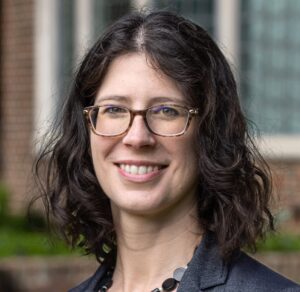
Elizabeth Jordan
Senior Program Officer, Ruth Mott Foundation