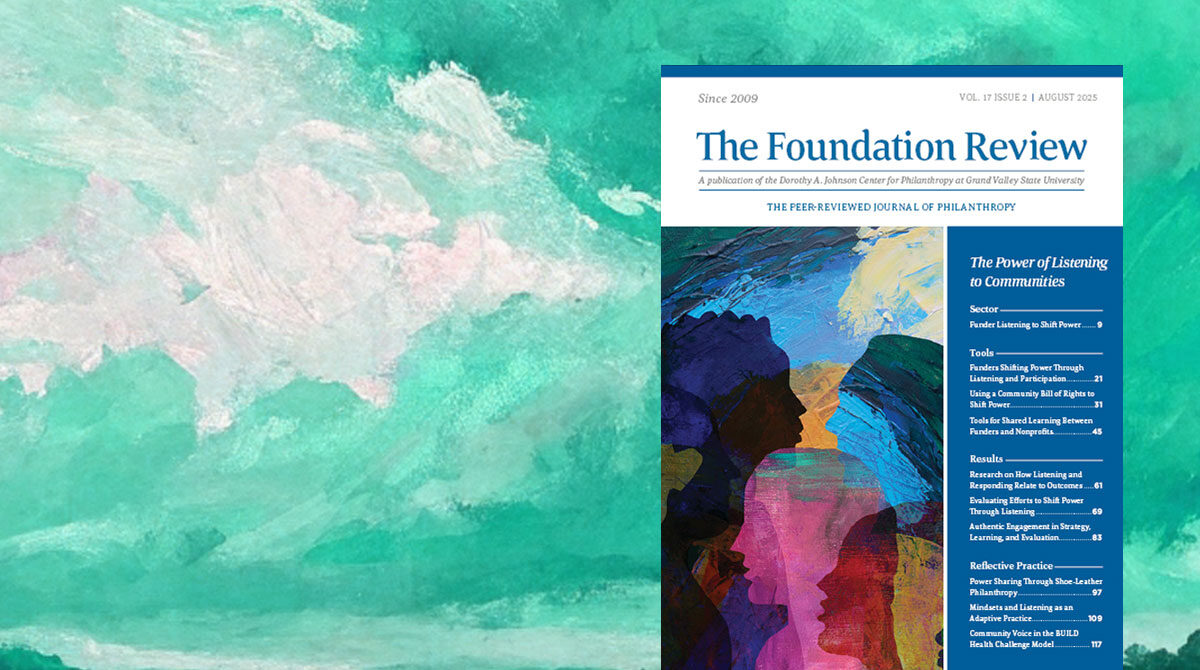
Editor’s note: We’re proud to highlight a special issue of The Foundation Review, “The Power of Listening to Communities,” sponsored by our partner Fund for Shared Insight. This collection marks an important moment for the field, bringing together learnings about how community-centered listening practices have the power to reshape philanthropy for the better. In an occasional blog series, we’ll hear directly from the authors featured in the special issue, lifting up their perspectives, calling out lessons learned, or offering updates on their work.
This post by Sonia Taddy-Sandino, who co-authored an article with colleagues at Engage R+D and The James Irvine Foundation, highlights takeaways from an Irvine community-engagement process. including the need for foundations to buy in, be transparent about roles, expectations, and boundaries, and to expect some messiness.
Over the last twenty-five years as a philanthropic learning and evaluation consultant, I’ve sat in countless rooms where foundations have convened grantees to “listen.” I’ve also been on the other side of the table as a nonprofit leader and understand what it looks like to be seen and heard by those who hold power and resources. When done authentically, it creates fertile ground for powerful relationships and transformative change. When done poorly, it generates cynicism and erodes trust.
Recently, I had the opportunity to support a multi-year grantee engagement to shape the strategy and evaluation for The James Irvine Foundation’s Just Prosperity Initiative. Reflecting on the experience, one grantee leader called the engagement “consequential” and “transformative, marking a significant departure from other historically opaque, foundation-centric approaches to strategy development.” Her reflection begged the questions: What made this engagement different and what can we learn from it?
As part of our Foundation Review article, Leaning into the Messiness of Authentic Engagement, in a special issue on “The Power of Listening to Communities,” my co-authors — Jennifer Ho, Kim Ammann Howard, and Clare Nolan — and I sought to unearth the core ingredients of authentic listening through a series of after-action interviews with foundation staff, consultants, and grantee leaders. While this work focused on engaging a smaller subset of grantees, we believe these insights are applicable to other types of community engagement efforts. In this post, we share some key takeaways and invite you to explore the full article.
Why this matters now
While a growing number of foundations have embraced trust-based practices and equitable evaluation principles, translating these commitments into sustained practice remains challenging. Competing agendas, inconsistent practices, and deeply rooted power dynamics often undermine well-intentioned efforts. Yet the need for authentic collaboration has never been more urgent. The systemic challenges we face demand that we find ways to work together differently.
Doubling down on authentic engagement
Rather than developing a strategy internally and then seeking grantee validation, Irvine created what it called a Design Circle of grantee leaders from community organizing, statewide advocacy, and research organizations early in the landscaping phase of an emerging statewide initiative. Throughout two cycles of engagement, this group pressure-tested the foundation’s assumptions, refined impact goals, and helped craft a bolder and sharper strategy. As part of the second engagement cycle, the Design Circle helped shape the evaluation approach, measures of success, and learning agenda.
Six practices that made the difference
- Design for iteration with a clear arc
Complex systems change is inherently messy and nonlinear. We learned people can tolerate messiness if they understand the overall journey and arc of engagement. We created a simple visual roadmap showing what we hoped to accomplish in each session while leaving space for emergence. Three focused virtual sessions (each about two hours in length) allowed us to build on previous conversations using a running slide deck that captured insights and made our thinking visible. Pre-reads of 1-3 pages with reflection questions helped participants come prepared, honoring their time while deepening the dialogue.
The key was finding the “delicate balance,” as one grantee noted, between creating multiple opportunities for input and respecting that “this is all time that we’re taking away from the work” happening on the front lines.
- Center relationships and bring together the right constellation
It’s equally important to be intentional about the composition of design groups and to be aware of the choices and tradeoffs. In addition to diverse perspectives, the foundation recruited leaders who could hold the “bigger we.” Not only did they bring expertise on a range of policy issues, they also had a solid track record of engaging diverse coalitions and ecosystem actors, including non-formal community leaders. To further ensure a diversity of perspectives, we also interviewed community organizing agencies and interest groups across the state and brought those insights into the group’s deliberations.
The size of the Design Circle was also an intentional choice. Having about a dozen participants (including a few foundation staff and consultants) kept the group manageable while ensuring rich discussion. The group’s ability to problem solve together, combined with pre-existing relationships and trust, allowed us to hit the ground running.
As one participant shared, “There was a lot of trust and confidence placed in us as practitioners to help Irvine develop its strategy in ways that didn’t just include our organizational perspective, but the wellbeing of the broader ecosystem.”
- Be transparent about roles, expectations, and boundaries
The foundation was explicit from the start. They weren’t seeking a rubber stamp but genuine thought partnership from grantee partners. It was also made clear that while grantees had substantial influence, the foundation board would ultimately approve the core elements of the initiative. The goal was alignment around shared direction and values, not consensus on every detail.
This required humility and willingness on the foundation’s part to let go of certain ideas. As one of Irvine’s program leaders reflected, “We came in with an idea of what it could be, and used the process to test and validate, but also sometimes to refine our initial thinking and assumptions.” Another foundation leader reflected, “It’s nice to say that you want to be inclusive but make sure that’s what your leadership or peers really want. Be honest with yourself and if that is true, then you need to build out a process that allows for that.”
- Demonstrate full leadership commitment
One grantee leader emphasized what made this different: “It wasn’t just the program officers being there in the space but (foundation) leadership showed up a lot too. There’s a lot of reciprocity of leadership on both sides.” This visible commitment and buy-in from decision makers across the foundation and grantee organizations underscored that success depended on mutual investment. Having witnessed many notable participatory processes in the past, those that lack buy-in from leadership often fade and fizzle. When push comes to shove, when things get uncomfortable, leaders who haven’t been part of the journey will revert to traditional approaches.
- Create space for ecosystem building
Systems change strategies involve multiple actors, and no single funder or group of advocates can go it alone. When Irvine convened its first in-person gathering for Just Prosperity grantees after the pandemic, the room overflowed. The energy confirmed what we heard repeatedly in interviews —there’s a tremendous appetite for spaces to build relationships and develop long-range strategies together.
We used varied formats including fishbowl activities and small group breakouts. Design Circle members led portions of the agenda, bringing their deep expertise in coalition building across issues and agendas. The experience underscored how important it is to design sessions that prioritize relationship building and make space for forming, storming, and norming (a model of team development) with diverse actors. This takes time, intentionality, patience, and scaffolding. Building those bridges is slow work. It’s also essential work.
As one leader at Irvine observed, some grantees were advocating not just for funding allies or organizations doing aligned work, but for “organizations where maybe we haven’t always had the best relationship but are important for solving the problem.” This helped expand the tent to include unlikely alliances among organizations that don’t always work together.
- Lean in, don’t step back
While critiques of philanthropy’s power imbalances are valid, stepping back entirely isn’t the answer. One Design Circle member captured this tension: “In philanthropy, there’s often two extremes, both of which are less than helpful. One extreme is the foundation dictates everything, and the other extreme is that the foundation just follows whatever folks in the community say needs to be done. Funders do have a viewpoint on the world and do have a set of expertise that is useful for us to build strategies and hold an analysis that’s more robust than it otherwise would be if we were doing it on our own.”
Grantees were clear about their expectations of the funder as an influencer and ally— calling on Irvine to use its convening power, contribute their perspective, and help drive alignment. As another participant noted, “When funders call, people come. Alignment will take time and only through interaction.”
The challenge is leaning in with the right posture — collaborative and supportive, rather than directive and controlling.
The reciprocal benefits
The Design Circle approach improved Irvine’s strategy in tangible ways. Engaging grantees from the outset gave the initiative greater credibility both within the foundation and in the broader ecosystem. As Just Prosperity’s director shared, “It was easier for us to move and advocate for the work [to the board], because it was done alongside grantees from the front-end and not on the backend.” As a result, the strategy itself became sharper and bolder, with more explicit focus on racial equity than might have emerged from an internal process alone.
For grantees, the benefits extended beyond influencing foundation strategy. The process created opportunities for cross-pollination of ideas among power-building, policy, and research practitioners who don’t always work closely together. It built relationships and alignment that will matter as the work unfolds over years.
The honest truth: It’s still messy
As noted earlier, there is legitimate skepticism when funders launch listening tours and convene grantees and community partners in participatory processes. We’ve all likely witnessed times when community input disappears behind closed doors — where decisions are obscure and promises about partnership dissolve under pressure.
Some grantees who attended Just Prosperity’s in-person gathering wondered if it was another dog and pony show or the beginning of genuinely new practices. Others questioned whether full alignment between funders and grantees is even achievable. This friction, while uncomfortable, represents real polarities we recognize even as we expand the tent. It demonstrates the ability to lean into the messiness rather than pretending it doesn’t exist.
As one Irvine leader reflected, folks may agree generally, “but when you get down to specifics, people have different ways of working. There is a trust building process that needs to happen. That will take time and there may actually be active disagreement on issues that need to be worked out.”
What this asks of all of us
In an era increasingly focused on efficiency and AI-powered solutions, this work asks us to slow down and invest in the relationships that are central to transforming complex systems.
For funders, authentic engagement requires leaning into relationships with the same discipline they bring to dashboards and due diligence. For nonprofit leaders, authentic engagement requires holding the idea of the bigger we to problem solve across organizational interests and build coalitions even with unlikely allies.
The long-term impacts of Irvine’s approach remain to be seen, but the immediate benefits —strengthened partnerships, sharper strategy, and enhanced problem-solving capabilities — should give funders and nonprofits across the board reason to hope and continue to lean into authentic engagement, no matter the challenges.