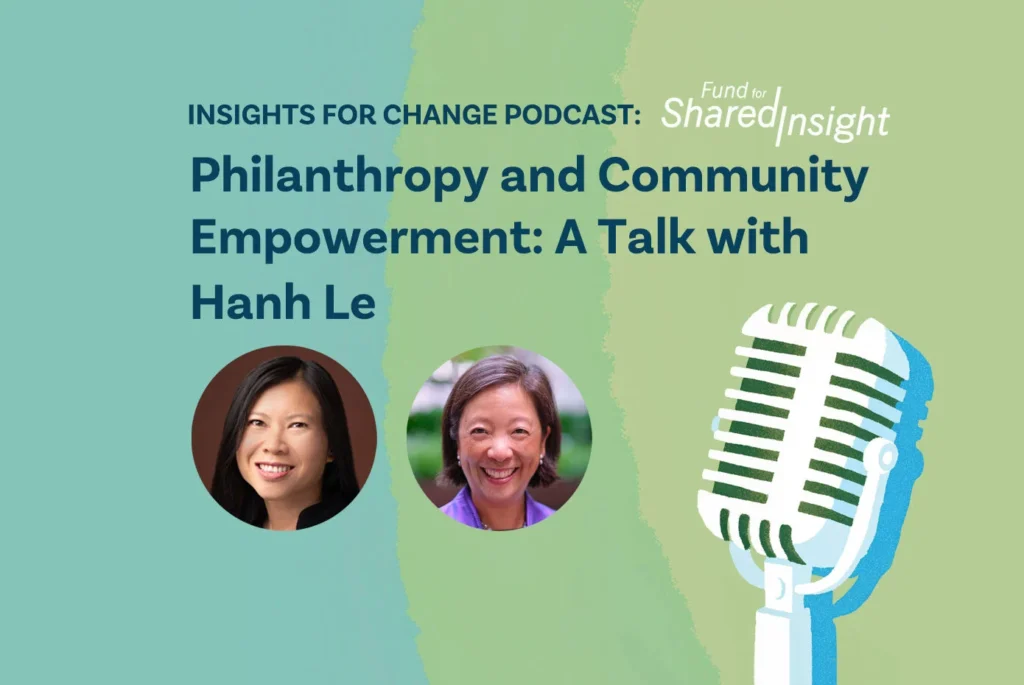
A new podcast from our partner Fund for Shared Insight spotlights one foundation’s commitment to listening as a core practice tied to racial justice and shifting power.
Melinda Tuan, Shared Insight’s managing director, talks with Hanh Le, co-CEO of iF, A Foundation for Radical Possibility, about iF’s origin and transformation, Le’s personal and professional journey, and practical lessons for funders seeking to deepen their listening practices to shift power.
When Le was a child, she fled Vietnam with her family, arriving in the U.S. in 1975 as a refugee. Early experiences of generosity and service shaped her sense of responsibility to others, eventually leading to a career in philanthropy, though it has not been without tension. Le reveals struggling with questions of belonging, power, and purpose.
Similar questions have emerged for Le at the institutional level, too, first when she headed a family foundation in Virginia, and now in her current position. Formerly the Consumer Health Foundation, which was created from proceeds of the sale of a health maintenance organization, iF undertook a deep examination of the company’s history, uncovering a record of racial exclusion and inequity.
“We are on a journey to reckon with that truth, acknowledge that truth, and actually engage and repair and redress with harmed communities based on that truth,” Le says.
Defining and reaching community
Explicitly stating who those harmed communities are — “those living at the sharpest intersections of systems of oppression, particularly race, class, and gender” — was iF’s starting point, Le says. And because these communities are least likely to already be part of philanthropy’s orbit, funders must “break down divides” to welcome in new voices and “equalize space so that folks feel comfortable showing up and sharing honestly.”
That can happen in different contexts, she says. For smaller, place-based foundations, direct engagement with community may feel more feasible. For large national foundations, identifying who counts as community and establishing deep local relationships can be harder. Partnering across funders can help: the Robert Wood Foundation worked with iF when the bigger funder wanted to make sure it was hearing from and responding to the communities it sought to support during COVID.
Funders must 'break down divides' to welcome in new voices and 'equalize space so that folks feel comfortable showing up and sharing honestly.'
Hanh Le, co-CEO of iF, A Foundation for Radical Possibility
Throughout the podcast, Le shares examples of how iF engages people with lived experience in the issues the foundation is addressing.
- By hosting convenings. In one learning series, community members, along with iF staff and leadership, learned about how foundations accumulate and deploy wealth. At a recent annual community event, called Confluence, the main topic for exploration was reparations.
- By organizing with community, not just funding their efforts. In iF’s guaranteed-income pilot, hospitality workers meant to benefit from the program participate directly in planning, learning, and advocacy efforts.
- By bringing community representation into decision-making roles. iF has employed participatory grantmaking approaches since 2018, recruits community members onto its governing board, and supports a two-year paid fellowship program intended to create a pathway into philanthropy careers for people from impacted communities.
- By co-creating strategies. iF engages communities harmed by the foundation’s wealth generation in designing strategies for its repair and redress work.
Listen to hear more about these practices, how to stay vigilant about listening, and how Le believes listening can “lead us to freedom.”