
Looking at your role/function within your foundation.
What are listening practices that can shift power?
Assess how you are listening through a set of reflection questions.
If you are a foundation donor — or work closely with donors — you have unique opportunities to shift your mindset from one of ownership over the organization’s wealth to one of stewarding resources into the hands and control of impacted communities. With this kind of reframing, defined by, and advanced through, listening to the people and communities your foundation seeks to serve, you’ll be creating a legacy of partnership that delivers resources where they are needed most.
Note: If you’re a fundraiser, take a look at what community-centric fundraising is all about.
Join a network of funders and donor organizers committed to building relationships with social movement leaders to provide support for transformational change toward a more just and collective future.
Resource Generation offers resources and programming to young people with wealth or class privilege, or who are involved in family foundations to learn more about philanthropy around social, racial, economic, or environmental justice. Use this guidance to help you make sense of all the opportunities to give and move your money in the direction of social change efforts led by people most impacted by injustice.
This guide invites you to reflect on four principles — accountability, equity, learning, and relationships — considering the meaning of each, how they manifest in your foundation’s philanthropic purpose, and how they show up in governance, grantmaking, and operations.
Pro tip: National Center for Family Philanthropy’s website offers additional resources to help families realize the purpose and potential of philanthropy for meaningful impact.
After Eileen Farbman inherited a family foundation she describes as conservative, she, her husband, and their son set out to turn it into something different, something “outside of the harmful practices they had seen in philanthropy and giving at large.” They would go on to create the Kolibri Foundation, working alongside three leaders in movements at the intersections of gender, racial, and economic justice, who also became trustees.
With bylaws at the new entity requiring that family members always represent a minority on the board, two additional movement leaders joined the original three alongside the three Farbmans to comprise the governing board.But even before the Farbmans reached outside the family to work on the foundation, they looked inward, clarifying commitments to communicate openly; be mindful of their own intentions and emotions and those of others; and to be inspired, challenged, and grateful. The result, a two-page document hashed out over a weekend workshop with consultants, was a set of “Shared Agreements” that the family continues to revisit regularly.
Says Farbman: “We felt we could not minimize the importance of family dynamics before stepping into relationships across class and race.”
In addition to the family agreements, the full board created a separate set of “Shared Community Agreements,” which is read before every board meeting. One of the agreements, which is about honoring opinions “rooted in different vantage points,” tells board members to “not let fear of power dynamics prevent us from saying what we think must be said.”
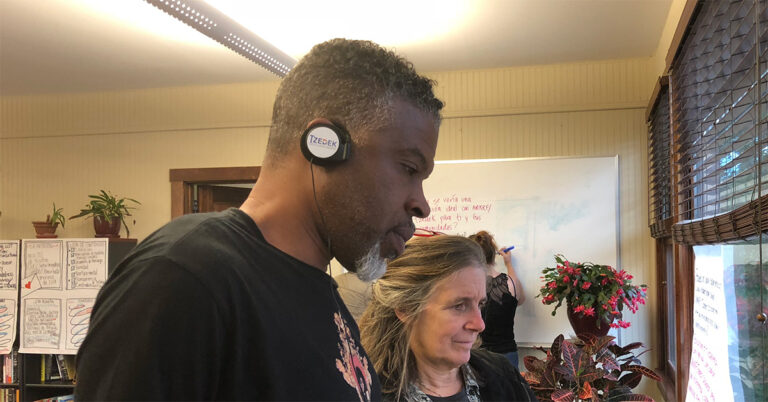
Through a community-based research process that tapped the wisdom of local movement leaders and grantee partners, the Tzedek Social Justice Fund recognized that it needed board members with direct experience doing the kind of work that Tzedek funds. Founder and donor Amy Mandel stepped down from the board, and Tzedek is now governed by a board of community leaders with diverse backgrounds and lived experience.
Mix and match to find the examples, resources, and reflections best suited to help you and your organization shift power to the people and communities at the heart of your work.
Funders are moving toward listening and participatory practices at different rates and from different starting points and perspectives. We also know that shifting power is not easy work and requires a strong internal commitment and continuous learning. It’s best to be clear on your organization’s motivations, capabilities, and goals. As you engage with this menu, consider your funding practices, operations, policies, and values — and then identify where change will best serve your foundation and the people and communities you seek to serve.
We recommend examining the menu’s resources and examples with a willingness to turn kernels of ideas into something right for you. No matter where you start or the path you travel through this menu, we suggest spending time on the reflection questions, perhaps engaging colleagues to help you and your organization better understand and prepare for what it means to listen to shift power.
Our Participatory Philanthropy Toolkit, included as a resource in the menu, has a Funder Readiness Assessment that can be adapted to different listening practices and help prepare you to make changes in your priorities and practices.
We offer a range of examples and resources because there are no one-size-fits-all solutions; and we share them in a menu format so you can choose what’s interesting or relevant to you and your foundation. We don’t rank the practices or the organizations employing them or intend to signal that any featured funder has met its listening goals across the board. Each example represents only a moment in time — a practice one of your peers told us (or an intermediary) about, and that we hope might inspire you to enhance your own listening work.
Similarly, we do not rank the resources, though we did select them based on a set of criteria, including:
New resources are always coming online. We hope that the ones we’ve included are helpful while also sparking your curiosity and helping you forge an ongoing relationship with the creators and other aligned efforts.
We are always looking to add more funder listening examples and more resources. Please reach out to our communications team.
Please reach out to our communications manager, Debra Blum.